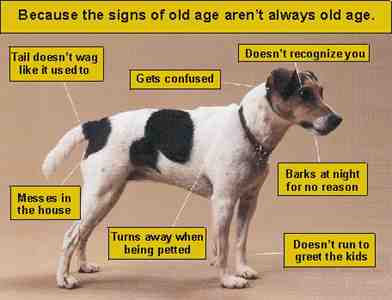
It’s heartbreaking to see our old dogs acting, well, old. You figure there’s nothing that can be done for a dog showing signs that resemble senility. This is just part of the aging process, right? Maybe not.
A remarkable medication, called Anipryl, was approved by the USDA in December of 1998 to treat age-related behavior changes (although it has been on veterinary shelves to treat canine Cushing’s disease, a hormonal imbalance). It may prove to be a lifesaver for countless senior dogs and could significantly improve the quality of their declining years and the pleasure you take in your dog. By enhancing dogs’ functioning, Anipryl can prevent or reduce many of the symptoms of old age that can disrupt a household.
Once a dog loses its housetraining, stops interacting with the family, begins to grow restless at night or to become lost even in its own home, many owners will decide that it’s time to put their beloved friend down. Those that don’t must face their dog’s progressive debility and the disruption and pain it can bring to the household. What they may not realize, however, is that sometimes these behaviors in old dogs that may look like senility or even Alzheimer’s in humans are now believed by many veterinarians to be part of an aging-associated brain disorder.
Some of these changes that are usually interpreted as the typical aging process could be due to potentially treatable medical conditions, such as tumors and infections, which are more common in older dogs; call your veterinarian for an appointment anytime your dog’s behavior changes suddenly.
A major source of behavior change in the aging dog, however, is very possibly the result of changes in the brain. This leads to the loss of cognitive abilities like thinking, memory, communication and problem solving. In some aspects it resembles Alzheimer’s disease in humans. This generalized medical condition has been designated Cognitive Dysfunction Syndrome or CDS for older dogs exhibiting this group of problematic, age-related behaviors.
Anipryl (the trade name for L-deprenyl or selegiline) may help CDS. In the absence of any physical cause such as cancer, infection, or organ failure, CDS is present when a dog shows one or more of the following five signs. See if your dog has any of these symptoms.
- Disorientation or confusion:
Your dog may wander aimlessly, stare out into space, or stand with his head in a corner; your dog may appear lost or confused in the house or yard; - Decreased or altered responsiveness to family member:
Your dog may fail to respond to your attention, and stop seeking out attention;
he may be less enthusiastic in his greeting; - Disturbances of the sleep-wake cycle:
Your dog may bark, whine or pace at night; he may persistently bark abnormally any time of the day; he may be sleeping more, or awake more at night; - Decreased activity level:
Your dog may show less general interest in his usual activities; - Deterioration in housetraining:
A normally housetrained dog is suddenly having “accidents”; your dog may signal less to go outside and may urinate or defecate indoors soon after being outside.
Given the possible benefits for CDS, Anipryl may well be worth trying when your dog is declining in ways that lead you to contemplate putting him or her down. If the normal course of aging and its difficulties are not disruptive for your household, you may not wish to consider medication. It’s a judgement call. But it’s nice to know that there’s help for your older pet and some of the often devastating signs of aging are not something we are forced to live with and accept anymore.